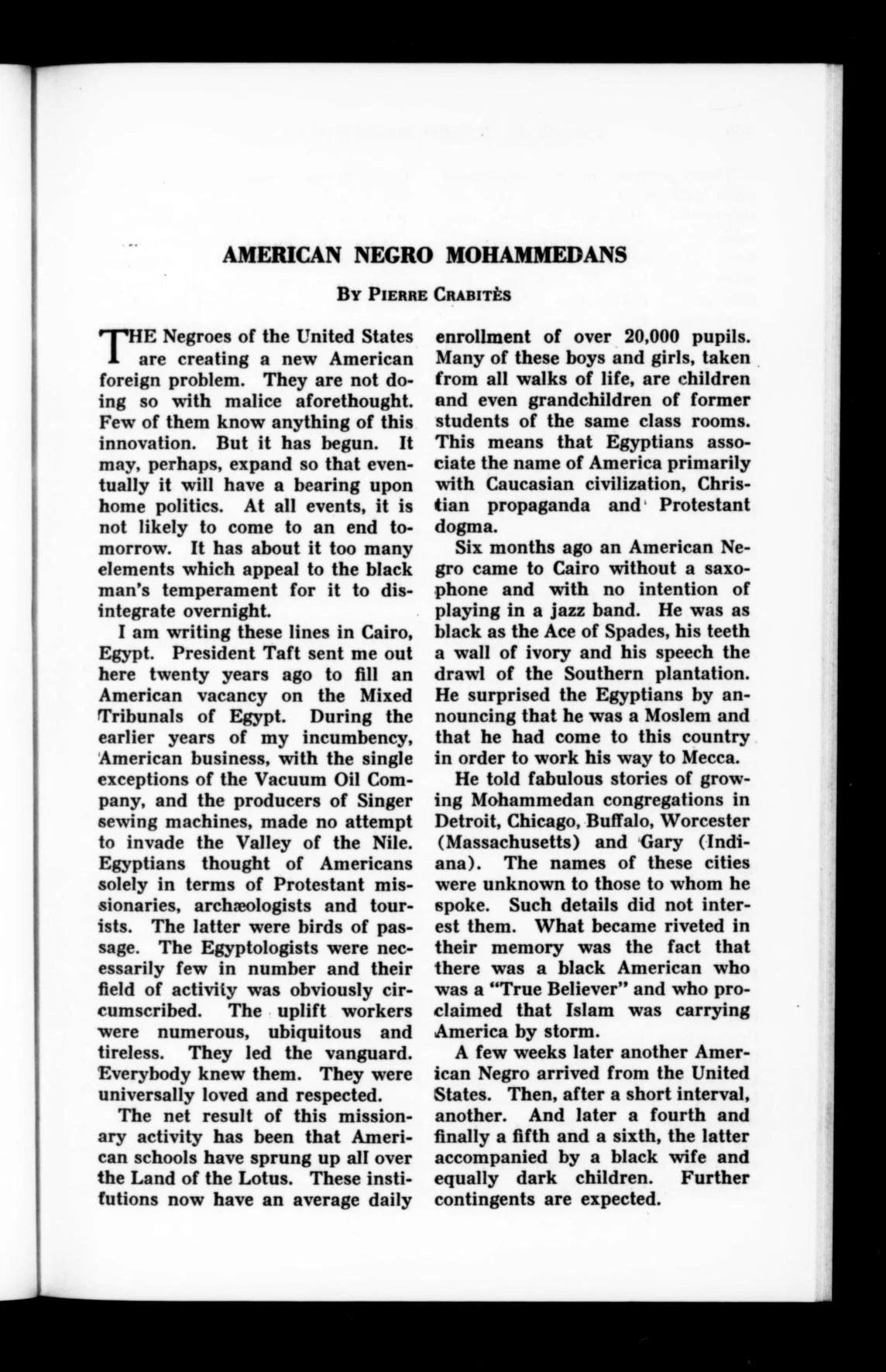
by Pierre Crabitès
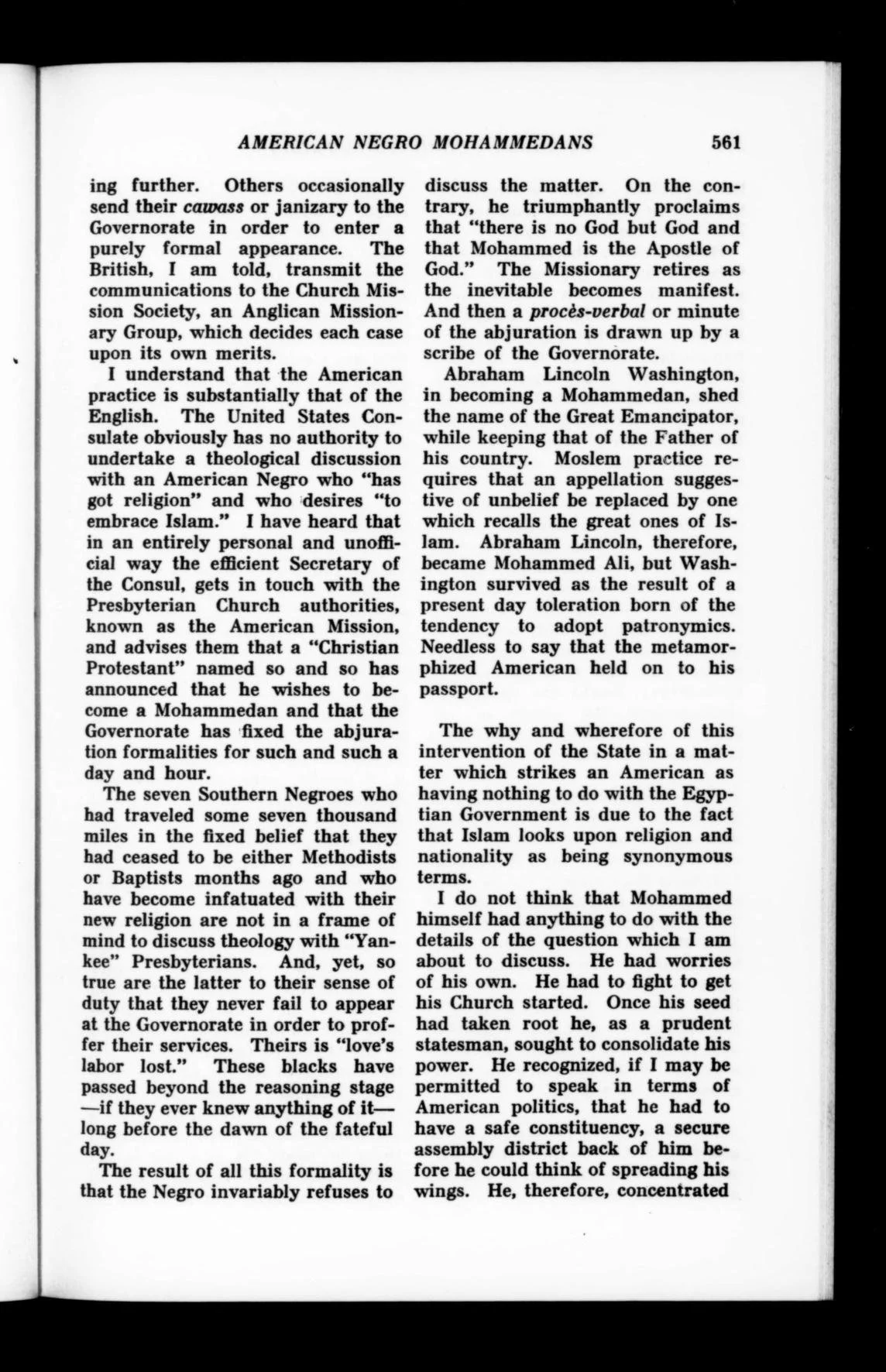
THE Negroes of the United States are creating a new American foreign problem. They are not doing so with malice aforethought. Few of them know anything of this innovation. But it has begun. It may, perhaps, expand so that eventually it will have a bearing upon. home politics. At all events, it is not likely to come to an end tomorrow. It has about it too many elements which appeal to the black man’s temperament for it to disintegrate overnight.
I am writing these lines in Cairo, Egypt. President Taft sent me out here twenty years ago to fill an American vacancy on the Mixed Tribunals of Egypt. During the earlier years of my incumbency, American business, with the single exceptions of the Vacuum Oil Company, and the producers of Singer sewing machines, made no attempt to invade the Valley of the Nile. Egyptians thought of Americans solely in terms of Protestant missionaries, archæologists and tourists. The latter were birds of passage. The Egyptologists were necessarily few in number and their field of activity was obviously circumscribed. The uplift workers were numerous, ubiquitous and tireless. They led the vanguard. Everybody knew them. They were universally loved and respected.
The net result of this missionary activity has been that American schools have sprung up all over the Land of the Lotus. These institutions now have an average daily enrollment of over 20,000 pupils. Many of these boys and girls, taken from all walks of life, are children and even grandchildren of former students of the same class rooms. This means that Egyptians associate the name of America primarily with Caucasian civilization, Christian propaganda and Protestant dogma.
Six months ago an American Negro came to Cairo without a saxophone and with no intention of playing in a jazz band. He was as black as the Ace of Spades, his teeth a wall of ivory and his speech the drawl of the Southern plantation. He surprised the Egyptians by announcing that he was a Moslem and that he had come to this country in order to work his way to Mecca.
He told fabulous stories of growing Mohammedan congregations in Detroit, Chicago, Buffalo, Worcester (Massachusetts) and Gary (Indiana). The names of these cities. were unknown to those to whom he spoke. Such details did not interest them. What became riveted in their memory was the fact that there was a black American who was a “True Believer” and who proclaimed that Islam was carrying America by storm.
A few weeks later another American Negro arrived from the United States. Then, after a short interval, another. And later a fourth and finally a fifth and a sixth, the latter accompanied by a black wife and equally dark children. Further contingents are expected.
These arrivals on the installment plan lend great weight to this immigration. Had all of these men come at once, Cairo would possibly have absorbed them and perhaps have forgotten about them. But this steady infiltration created the impression that an endless chain had been set in motion. And, of course. Oriental imagination embroidered upon this fabric most glowing tales of America’s being a black man’s country dominated by Mohammedans.
These facts were not featured by the press. The vernacular papers have an Oriental and not an Occidental idea of news. The story. however, got into the bazaars and into harems. It was made the subject of an inquiry by the Cairo Governorate. It was brought officially to the attention of the American Consulate.
In other words, when these colored men and their ebony sister announced that they were Mohammedans they forgot that they were not in the United States. They overlooked the fact that in the Orient religion is not merely a question of conscience but that it is also an affair of State. They did not know that in the Levant conversion, like naturalization, requires official red tape.
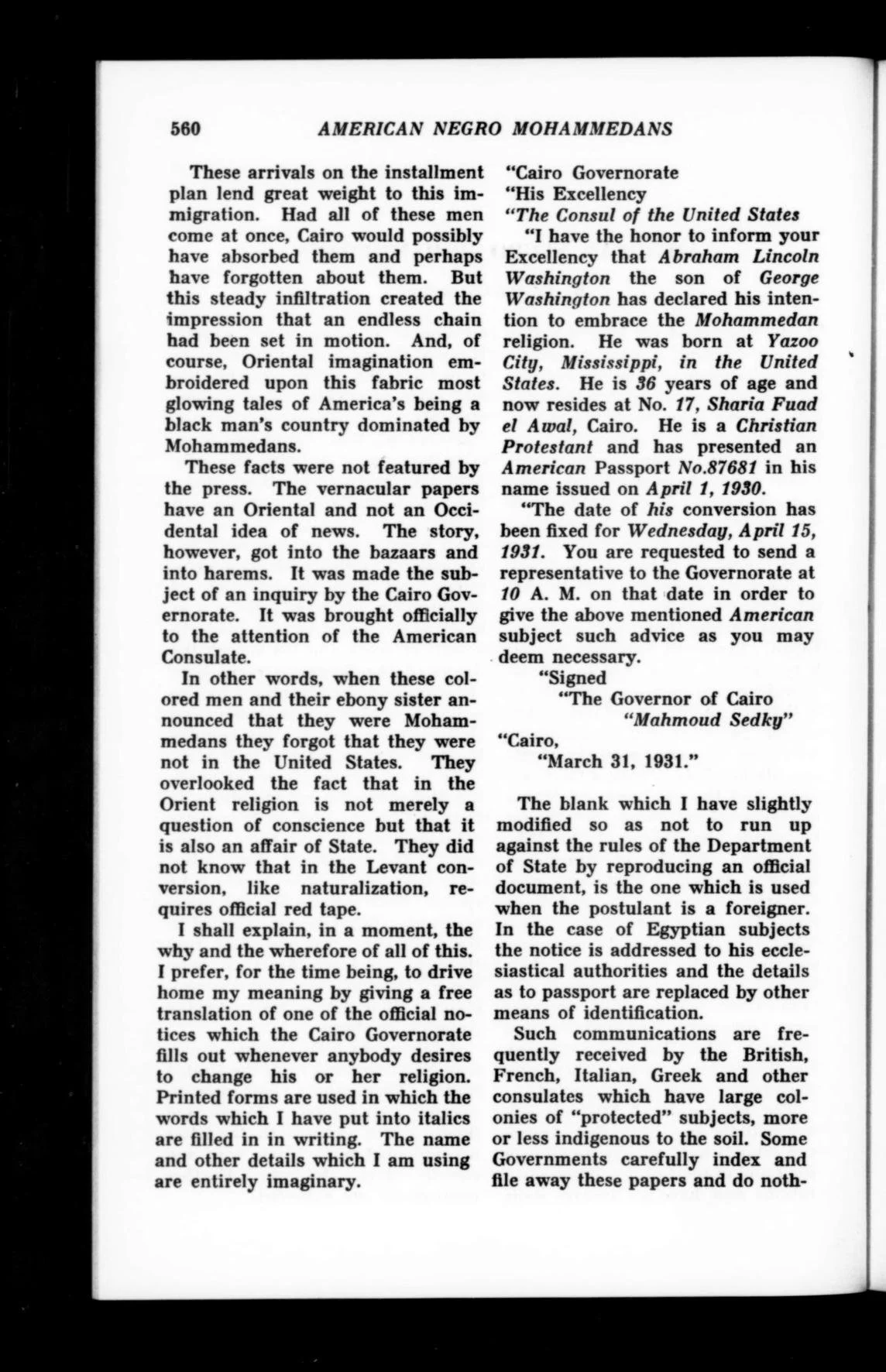
I shall explain, in a moment, the why and the wherefore of all of this. I prefer, for the time being, to drive home my meaning by giving a free translation of one of the official notices which the Cairo Governorate fills out whenever anybody desires to change his or her religion. Printed forms are used in which the words which I have put into italics are filled in in writing. The name and other details which I am using are entirely imaginary.
“Cairo Governorate
“His Excellency
“The Consul of the United States
“I have the honor to inform your Excellency that Abraham Lincoln Washington the son of George Washington has declared his intention to embrace the Mohammedan religion. He was born at Yazoo City, Mississippi, in the United States. He is 36 years of age and now resides at No. 17, Sharia Fuad el Awal, Cairo. He is a Christian Protestant and has presented an American Passport No.87681 in his name issued on April 1, 1930.
“The date of his conversion has been fixed for Wednesday, April 15, 1931. You are requested to send a representative to the Governorate at 10 A.M. on that date in order to give the above mentioned American subject such advice as you may deem necessary.
“Signed “The Governor of Cairo “Mahmoud Sedky”
“Cairo “March 31, 1931.”
The blank which I have slightly modified so as not to run up against the rules of the Department of State by reproducing an official document, is the one which is used when the postulant is a foreigner. In the case of Egyptian subjects the notice is addressed to his ecclesiastical authorities and the details as to passport are replaced by other means of identification.
Such communications are frequently received by the British, French, Italian, Greek and other consulates which have large colonies of “protected” subjects, more or less indigenous to the soil. Some Governments carefully index and file away these papers and do nothing further. Others occasionally send their cawass or janizary to the Governorate in order to enter a purely formal appearance. The British, I am told, transmit the communications to the Church Mission Society, an Anglican Missionary Group, which decides each case upon its own merits.
I understand that the American practice is substantially that of the English. The United States Consulate obviously has no authority to undertake a theological discussion with an American Negro who “has got religion” and who desires “to embrace Islam.” I have heard that in an entirely personal and unofficial way the efficient Secretary of the Consul, gets in touch with the Presbyterian Church authorities, known as the American Mission, and advises them that a “Christian Protestant” named so and so has announced that he wishes to become a Mohammedan and that the Governorate has fixed the abjuration formalities for such and such a day and hour.
The seven Southern Negroes who had traveled some seven thousand miles in the fixed belief that they had ceased to be either Methodists or Baptists months ago and who have become infatuated with their new religion are not in a frame of mind to discuss theology with “Yankee” Presbyterians. And, yet, so true are the latter to their sense of duty that they never fail to appear at the Governorate in order to proffer their services. Theirs is “love’s labor lost.” These blacks have passed beyond the reasoning stage — if they ever knew anything of it — long before the dawn of the fateful day.
The result of all this formality is that the Negro invariably refuses to discuss the matter. On the contrary, he triumphantly proclaims that “there is no God but God and that Mohammed is the Apostle of God.” The Missionary retires as the inevitable becomes manifest. And then a procès-verbal or minute of the abjuration is drawn up by a scribe of the Governorate.
Abraham Lincoln Washington, in becoming a Mohammedan, shed the name of the Great Emancipator, while keeping that of the Father of his country. Moslem practice requires that an appellation suggestive of unbelief be replaced by one which recalls the great ones of Islam. Abraham Lincoln, therefore, became Mohammed Ali, but Washington survived as the result of a present day toleration born of the tendency to adopt patronymics. Needless to say that the metamorphized American held on to his passport.
The why and wherefore of this intervention of the State in a matter which strikes an American as having nothing to do with the Egyptian Government is due to the fact that Islam looks upon religion and nationality as being synonymous terms.
I do not think that Mohammed himself had anything to do with the details of the question which I am about to discuss. He had worries of his own. He had to fight to get his Church started. Once his seed had taken root he, as a prudent statesman, sought to consolidate his power. He recognized, if I may be permitted to speak in terms of American politics, that he had to have a safe constituency, a secure assembly district back of him before he could think of spreading his wings. He, therefore, concentrated his attention upon welding the tribes of Arabia into a compact, cohesive and combative unit.
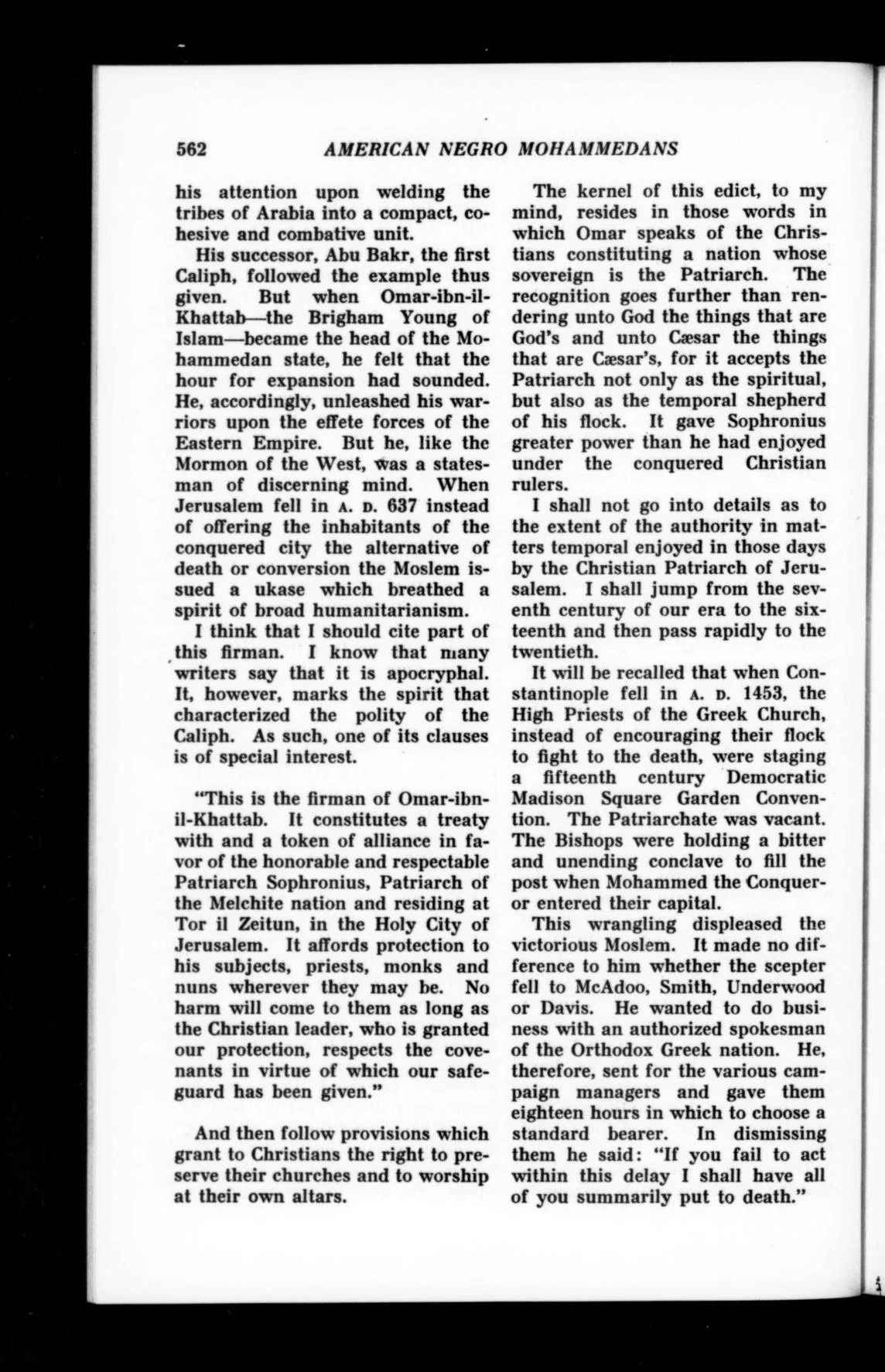
His successor, Abu Bakr, the first Caliph, followed the example thus given. But when Omar-ibn-il-Khattab — the Brigham Young of Islam — became the head of the Mohammedan state, he felt that the hour for expansion had sounded. He, accordingly, unleashed his warriors upon the effete forces of the Eastern Empire. But he, like the Mormon of the West, was a statesman of discerning mind. When Jerusalem fell in A. D. 637 instead of offering the inhabitants of the conquered city the alternative of death or conversion the Moslem issued a ukase which breathed a spirit of broad humanitarianism.
I think that I should cite part of this firman. I know that many writers say that it is apocryphal. It, however, marks the spirit that characterized the polity of the Caliph. As such, one of its clauses is of special interest.
“This is the firman of Omar-ibn-il-Khattab. It constitutes a treaty with and a token of alliance in favor of the honorable and respectable Patriarch Sophronius, Patriarch of the Melchite nation and residing at Tor il Zeitun, in the Holy City of Jerusalem. It affords protection to his subjects, priests, monks and nuns wherever they may be. No harm will come to them as long as the Christian leader, who is granted our protection, respects the covenants in virtue of which our safeguard has been given.”
And then follow provisions which grant to Christians the right to preserve their churches and to worship at their own altars.
The kernel of this edict, to my mind, resides in those words in which Omar speaks of the Christians constituting a nation whose sovereign is the Patriarch. The recognition goes further than rendering unto God the things that are God’s and unto Caesar the things that are Caesar’s, for it accepts the Patriarch not only as the spiritual, but also as the temporal shepherd of his flock. It gave Sophronius greater power than he had enjoyed under the conquered Christian rulers.
I shall not go into details as to the extent of the authority in matters temporal enjoyed in those days by the Christian Patriarch of Jerusalem. I shall jump from the seventh century of our era to the sixteenth and then pass rapidly to the twentieth.
It will be recalled that when Constantinople fell in A. D. 1453, the High Priests of the Greek Church, instead of encouraging their flock to fight to the death, were staging a fifteenth century Democratic Madison Square Garden Convention. The Patriarchate was vacant. The Bishops were holding a bitter and unending conclave to fill the post when Mohammed the Conqueror entered their capital.
This wrangling displeased the victorious Moslem. It made no difference to him whether the scepter fell to McAdoo, Smith, Underwood or Davis. He wanted to do business with an authorized spokesman of the Orthodox Greek nation. He, therefore, sent for the various campaign managers and gave them eighteen hours in which to choose a standard bearer. In dismissing them he said: “If you fail to act within this delay I shall have all of you summarily put to death.”
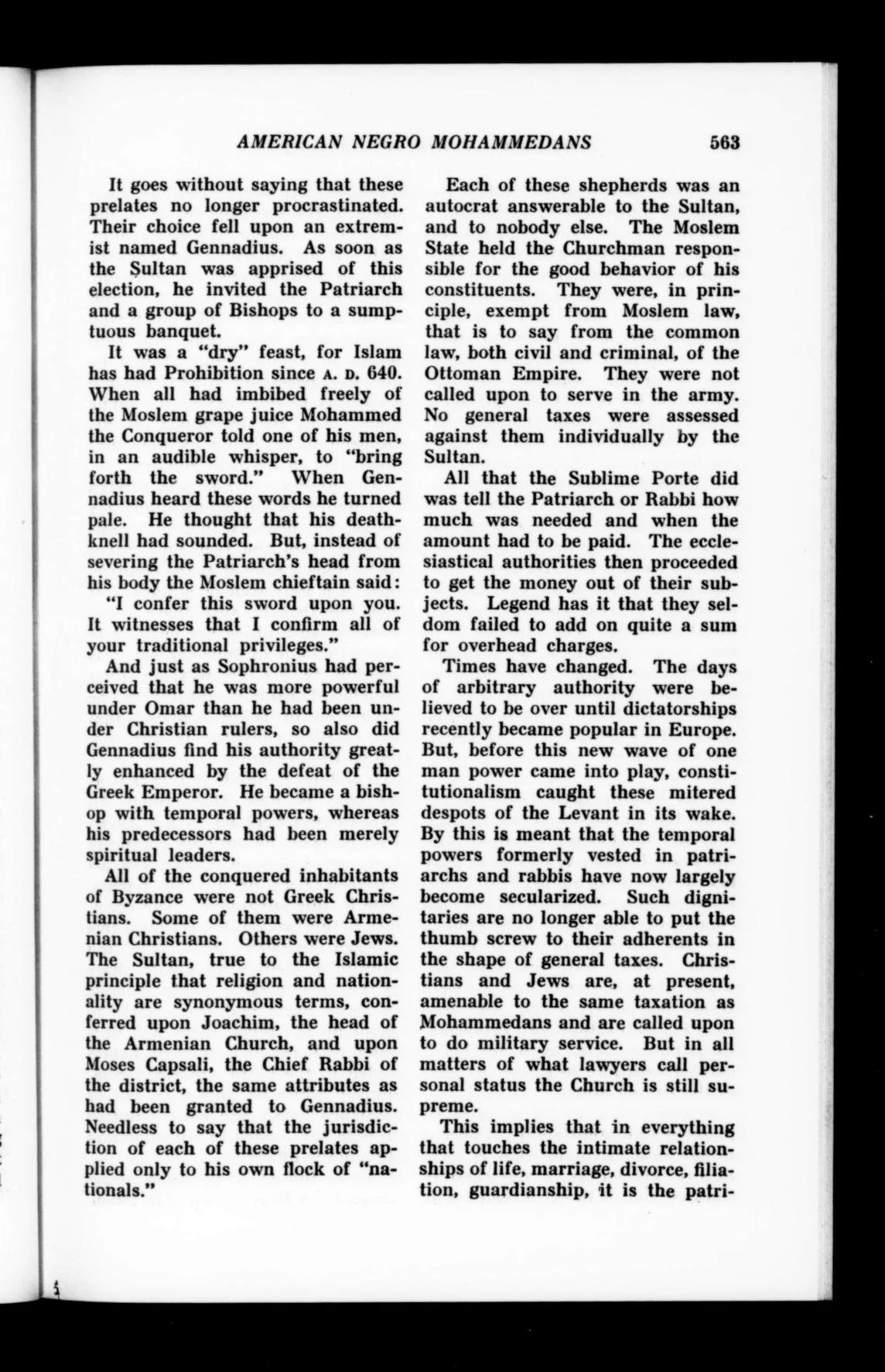
It goes without saying that these prelates no longer procrastinated. Their choice fell upon an extremist named Gennadius. As soon as the Sultan was apprised of this election, he invited the Patriarch and a group of Bishops to a sumptuous banquet.
It was a “dry” feast, for Islam has had Prohibition since A. D. 640. When all had imbibed freely of the Moslem grape juice Mohammed the Conqueror told one of his men, in an audible whisper, to “bring forth the sword.” When Gennadius heard these words he turned pale. He thought that his death knell had sounded. But, instead of severing the Patriarch’s head from his body the Moslem chieftain said:
“I confer this sword upon you. It witnesses that I confirm all of your traditional privileges.”
And just as Sophronius had perceived that he was more powerful under Omar than he had been under Christian rulers, so also did Gennadius find his authority greatly enhanced by the defeat of the Greek Emperor. He became a bishop with temporal powers, whereas his predecessors had been merely spiritual leaders.
All of the conquered inhabitants of Byzance were not Greek Christians. Some of them were Armenian Christians. Others were Jews. The Sultan, true to the Islamic principle that religion and nationality are synonymous terms, conferred upon Joachim, the head of the Armenian Church, and upon Moses Capsali, the Chief Rabbi of the district, the same attributes as had been granted to Gennadius. Needless to say that the jurisdiction of each of these prelates applied only to his own flock of “nationals.”
Each of these shepherds was an autocrat answerable to the Sultan, and to nobody else. The Moslem State held the Churchman responsible for the good behavior of his constituents. They were, in principle, exempt from Moslem law, that is to say from the common law, both civil and criminal, of the Ottoman Empire. They were not called upon to serve in the army. No general taxes were assessed against them individually by the Sultan.
All that the Sublime Porte did was tell the Patriarch or Rabbi how much was needed and when the amount had to be paid. The ecclesiastical authorities then proceeded to get the money out of their subjects. Legend has it that they seldom failed to add on quite a sum for overhead charges.
Times have changed. The days of arbitrary authority were believed to be over until dictatorships recently became popular in Europe. But, before this new wave of one man power came into play, constitutionalism caught these mitered despots of the Levant in its wake. By this is meant that the temporal powers formerly vested in patriarchs and rabbis have now largely become secularized. Such dignitaries are no longer able to put the thumb screw to their adherents in the shape of general taxes. Christians and Jews are, at present, amenable to the same taxation as Mohammedans and are called upon to do military service. But in all matters of what lawyers call personal status the Church is still supreme.
This implies that in everything that touches the intimate relationships of life, marriage, divorce, filiation, guardianship, it is the patriarch and rabbi who still act as the temporal judge of their nationals.
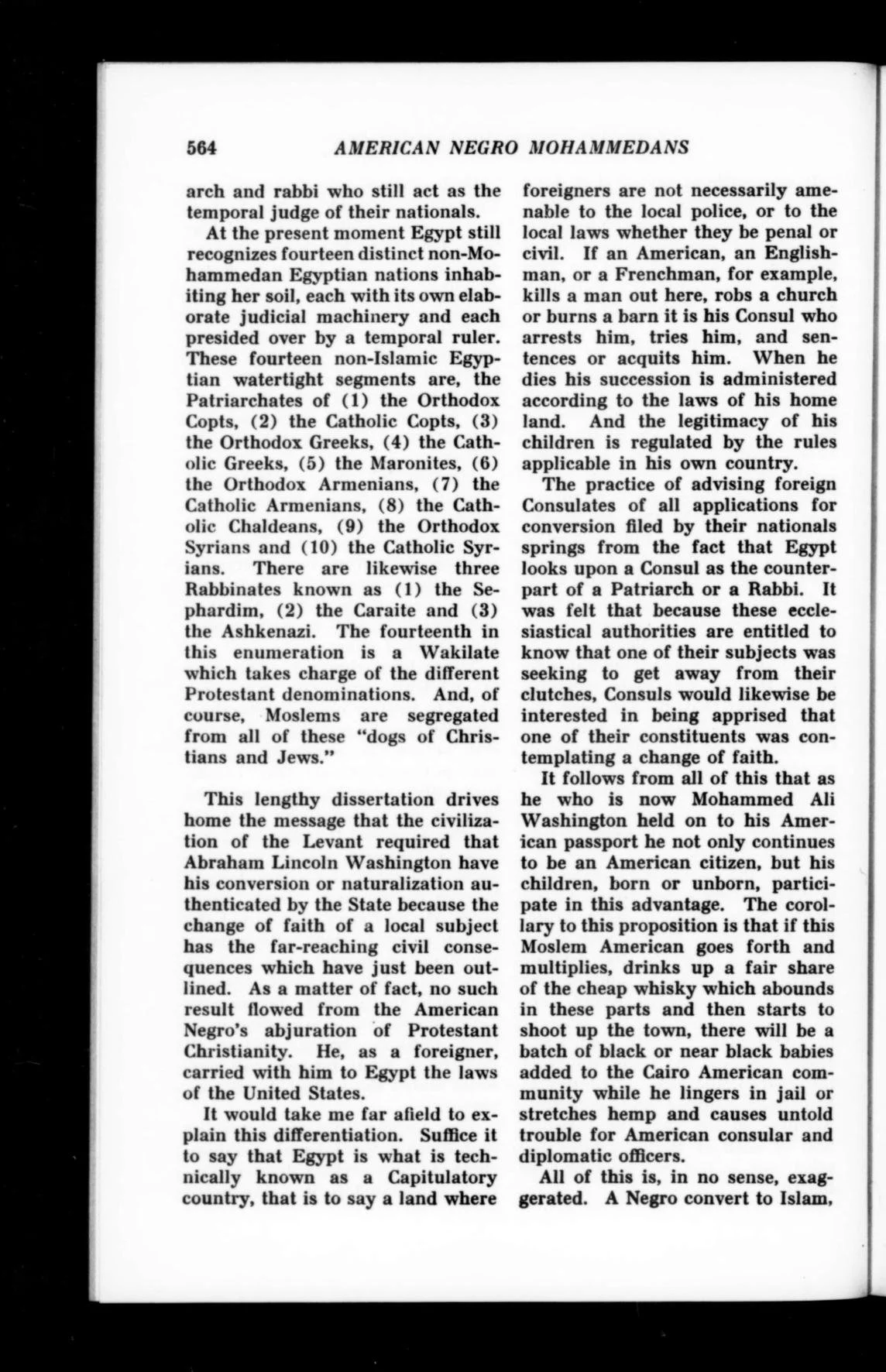
At the present moment Egypt still recognizes fourteen distinct non-Mohammedan Egyptian nations inhabiting her soil, each with its own elaborate judicial machinery and each presided over by a temporal ruler. These fourteen non-Islamic Egyptian watertight segments are, the Patriarchates of (1) the Orthodox Copts, (2) the Catholic Copts, (3) the Orthodox Greeks, (4) the Catholic Greeks, (5) the Maronites, (6) the Orthodox Armenians, (7) the Catholic Armenians, (8) the Catholic Chaldeans, (9) the Orthodox Syrians and (10) the Catholic Syrians. There are likewise three Rabbinates known as (1) the Sephardim, (2) the Caraite and (3) the Ashkenazi. The fourteenth in this enumeration is a Wakilate which takes charge of the different Protestant denominations. And, of course, Moslems are segregated from all of these “dogs of Christians and Jews.”
This lengthy dissertation drives home the message that the civilization of the Levant required that Abraham Lincoln Washington have his conversion or naturalization authenticated by the State because the change of faith of a local subject has the far-reaching civil consequences which have just been outlined. As a matter of fact, no such result flowed from the American Negro’s abjuration of Protestant Christianity. He, as a foreigner, carried with him to Egypt the laws of the United States.
It would take me far afield to explain this differentiation. Suffice it to say that Egypt is what is technically known as a Capitulatory country, that is to say a land where foreigners are not necessarily amenable to the local police, or to the local laws whether they be penal or civil. If an American, an Englishman, or a Frenchman, for example, kills a man out here, robs a church or burns a barn it is his Consul who arrests him, tries him, and sentences or acquits him. When he dies his succession is administered according to the laws of his home land. And the legitimacy of his children is regulated by the rules applicable in his own country.
The practice of advising foreign Consulates of all applications for conversion filed by their nationals springs from the fact that Egypt looks upon a Consul as the counterpart of a Patriarch or a Rabbi. It I was felt that because these ecclesiastical authorities are entitled to know that one of their subjects was seeking to get away from their clutches, Consuls would likewise be interested in being apprised that one of their constituents was contemplating a change of faith.
It follows from all of this that as he who is now Mohammed Ali Washington held on to his American passport he not only continues to be an American citizen, but his children, born or unborn, participate in this advantage. The corollary to this proposition is that if this Moslem American goes forth and multiplies, drinks up a fair share of the cheap whisky which abounds in these parts and then starts to shoot up the town, there will be a batch of black or near black babies added to the Cairo American community while he lingers in jail or stretches hemp and causes untold trouble for American consular and diplomatic officers.
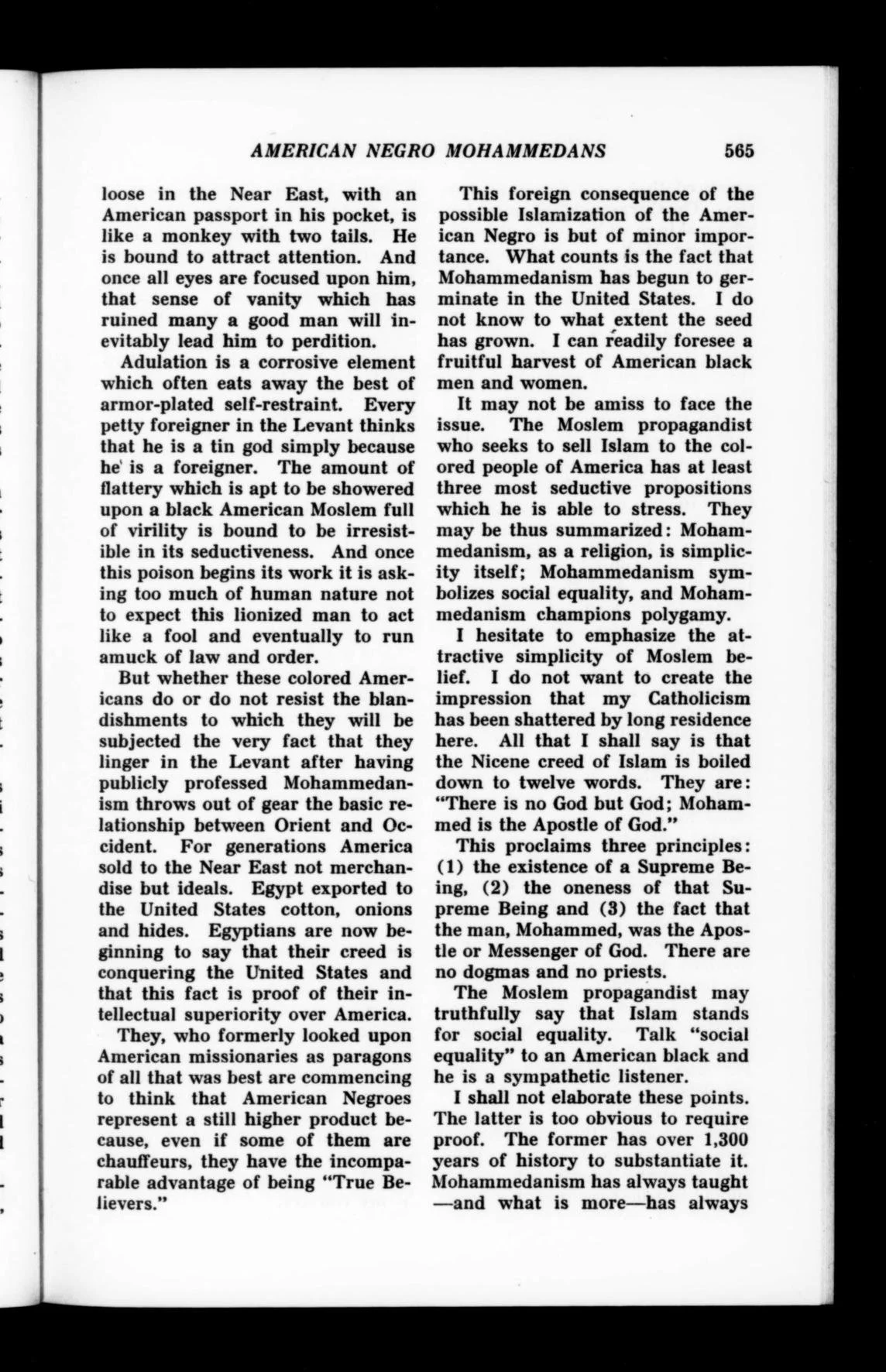
All of this is, in no sense, exaggerated. A Negro convert to Islam, loose in the Near East, with an American passport in his pocket, is like a monkey with two tails. He is bound to attract attention. And once all eyes are focused upon him, that sense of vanity which has ruined many a good man will inevitably lead him to perdition.
Adulation is a corrosive element which often eats away the best of armor-plated self-restraint. Every petty foreigner in the Levant thinks that he is a tin god simply because he is a foreigner. The amount of flattery which is apt to be showered upon a black American Moslem full of virility is bound to be irresistible in its seductiveness. And once this poison begins its work it is asking too much of human nature not to expect this lionized man to act like a fool and eventually to run amuck of law and order.
But whether these colored Americans do or do not resist the blandishments to which they will be subjected the very fact that they linger in the Levant after having publicly professed Mohammedanism throws out of gear the basic relationship between Orient and Occident. For generations America sold to the Near East not merchandise but ideals. Egypt exported to the United States cotton, onions and hides. Egyptians are now beginning to say that their creed is conquering the United States and that this fact is proof of their intellectual superiority over America.
They, who formerly looked upon American missionaries as paragons of all that was best are commencing to think that American Negroes represent a still higher product because, even if some of them are chauffeurs, they have the incomparable advantage of being “True Believers.”
This foreign consequence of the possible Islamization of the American Negro is but of minor importance. What counts is the fact that Mohammedanism has begun to germinate in the United States. I do not know to what extent the seed has grown. I can readily foresee a fruitful harvest of American black men and women.
It may not be amiss to face the issue. The Moslem propagandist who seeks to sell Islam to the colored people of America has at least three most seductive propositions which he is able to stress. They may be thus summarized: Mohammedanism, as a religion, is simplicity itself; Mohammedanism symbolizes social equality, and Mohammedanism champions polygamy.
I hesitate to emphasize the attractive simplicity of Moslem belief. I do not want to create the impression that my Catholicism has been shattered by long residence here. All that I shall say is that the Nicene creed of Islam is boiled down to twelve words. They are: “There is no God but God; Mohammed is the Apostle of God.”
This proclaims three principles: (1) the existence of a Supreme Being, (2) the oneness of that Supreme Being and (3) the fact that the man, Mohammed, was the Apostle or Messenger of God. There are no dogmas and no priests.
The Moslem propagandist may truthfully say that Islam stands for social equality. Talk “social equality” to an American black and he is a sympathetic listener.
I shall not elaborate these points. The latter is too obvious to require proof. The former has over 1,300 years of history to substantiate it. Mohammedanism has always taught — and what is more — has always practiced that color forms no barrier. The Circassian Mohammedan, whose skin is white, looks upon the Sudanese Moslem, whose pigment is black, as his brother and deals with him as such if there be the slightest intellectual affinity between them. Princes in the old days treated as absolute equals their sons born of white wives and those begotten of black slaves.
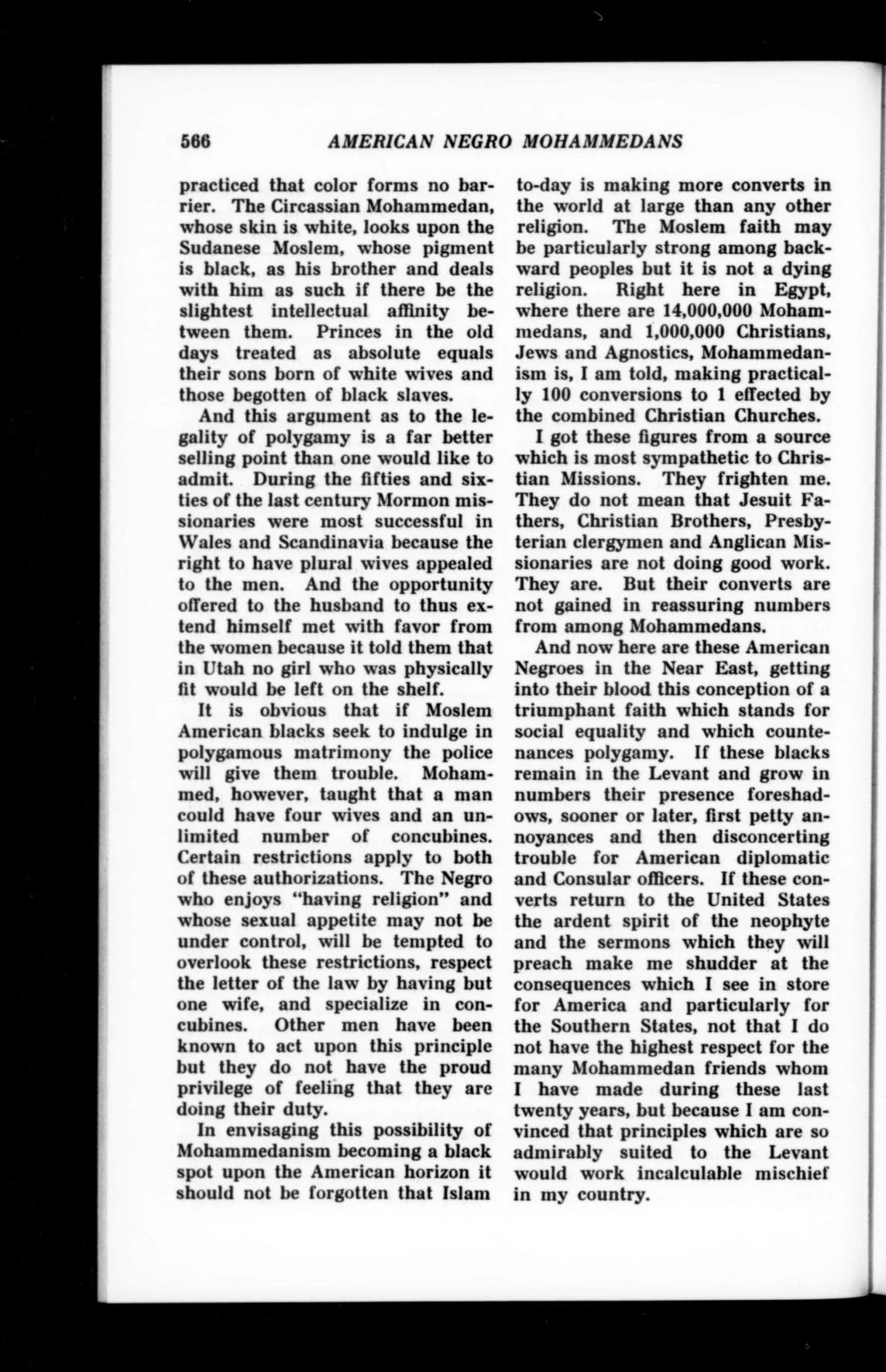
And this argument as to the legality of polygamy is a far better selling point than one would like to admit. During the fifties and sixties of the last century Mormon missionaries were most successful in Wales and Scandinavia because the right to have plural wives appealed to the men. And the opportunity offered to the husband to thus extend himself met with favor from the women because it told them that in Utah no girl who was physically fit would be left on the shelf.
It is obvious that if Moslem American blacks seek to indulge in polygamous matrimony the police will give them trouble. Mohammed, however, taught that a man could have four wives and an unlimited number of concubines. Certain restrictions apply to both of these authorizations. The Negro who enjoys “having religion” and whose sexual appetite may not be under control, will be tempted to overlook these restrictions, respect the letter of the law by having but one wife, and specialize in concubines. Other men have been known to act upon this principle but they do not have the proud privilege of feeling that they are doing their duty.
In envisaging this possibility of Mohammedanism becoming a black spot upon the American horizon it should not be forgotten that Islam today is making more converts in the world at large than any other religion. The Moslem faith may be particularly strong among backward peoples but it is not a dying religion. Right here in Egypt, where there are 14,000,000 Mohammedans, and 1,000,000 Christians, Jews and Agnostics, Mohammedanism is, I am told, making practically 100 conversions to 1 effected by the combined Christian Churches.
I got these figures from a source which is most sympathetic to Christian Missions. They frighten me. They do not mean that Jesuit Fathers, Christian Brothers, Presbyterian clergymen and Anglican Missionaries are not doing good work. They are. But their converts are not gained in reassuring numbers from among Mohammedans.
And now here are these American Negroes in the Near East, getting into their blood this conception of a triumphant faith which stands for social equality and which countenances polygamy. If these blacks remain in the Levant and grow in numbers their presence foreshadows, sooner or later, first petty annoyances and then disconcerting trouble for American diplomatic and Consular officers. If these converts return to the United States the ardent spirit of the neophyte and the sermons which they will preach make me shudder at the consequences which I see in store for America and particularly for the Southern States, not that I do not have the highest respect for the many Mohammedan friends whom I have made during these last twenty years, but because I am convinced that principles which are so admirably suited to the Levant would work incalculable mischief in my country.
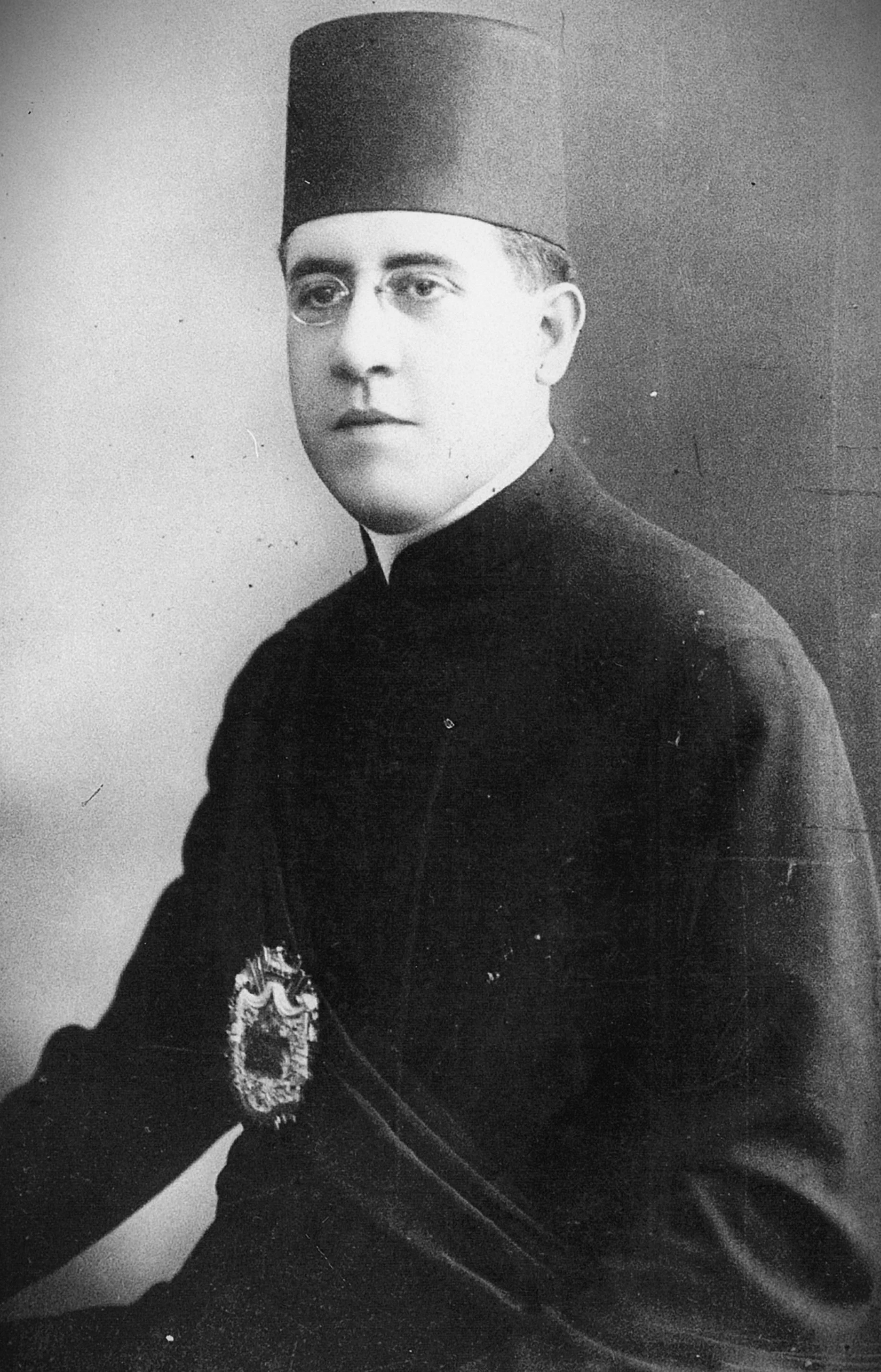
Pierre Crabitès

Dr. John Andrew Morrow: The Complete History of W.D. Fard is a tremendous work and invaluable resource. These are like Hadith from W.D. Fard… sayings, stories… all of that sheds incredible light into his ideology and it’s origins.
Brother Alam Khan: The Complete History of W.D. Fard (450 pages), by Alam Khan Publications, embarks on an ambitious endeavor to shed new light on the founder of the Nation of Islam, offering a meticulously curated compilation of rare sources that challenge conventional understandings. This book is a deep dive into a treasure trove of primary materials that have remained obscured.
Part One focuses on over twenty eyewitness testimonies from individuals who knew or encountered W.D. Fard, most notably the intimate accounts from the trusted brother of Elijah Mohammed, John Mohammed. These newly transcribed lectures, sourced from the YouTube channel “SUPREME MINISTER JOHN MUHAMMAD” and released by Salaam Allah, his personal cameraman, are a cornerstone of this work. The recordings capture never heard before insights into W.D. Fard’s teachings, persona, and background. These transcriptions, which have never been put into writing, offer readers a new perspective which was previously inaccessible. Rare testimony of Elijah Mohammed is also included, as well as his other brothers Jam, Johnnie, and Wali.
Part Two assembles a collection of historical newspapers, providing critical contemporary accounts of W.D. Fard and the events surrounding his three years in Detroit. These articles, often overlooked or forgotten, serve as a window into the public perception and media portrayal of W.D. Fard during his time.
Part Three rounds out this comprehensive exploration by presenting a diverse array of documents, letters, and photographs. This tangible evidence complements and verifies the personal accounts and media portrayals.
By presenting the material without commentary, this work invites readers to engage directly with the evidence, to question prevailing narratives, and to draw their own conclusions. Upon completing this book, readers will find themselves questioning their prior understanding of W.D. Fard and wondering what has yet to be uncovered.
Please allow approximately twenty days to receive package and approximately ten days to receive tracking. Each book is printed brand new and shipped once finished.
